Why North American Pilgrims Are Paying More Than Ever
FINANCE & FAITH
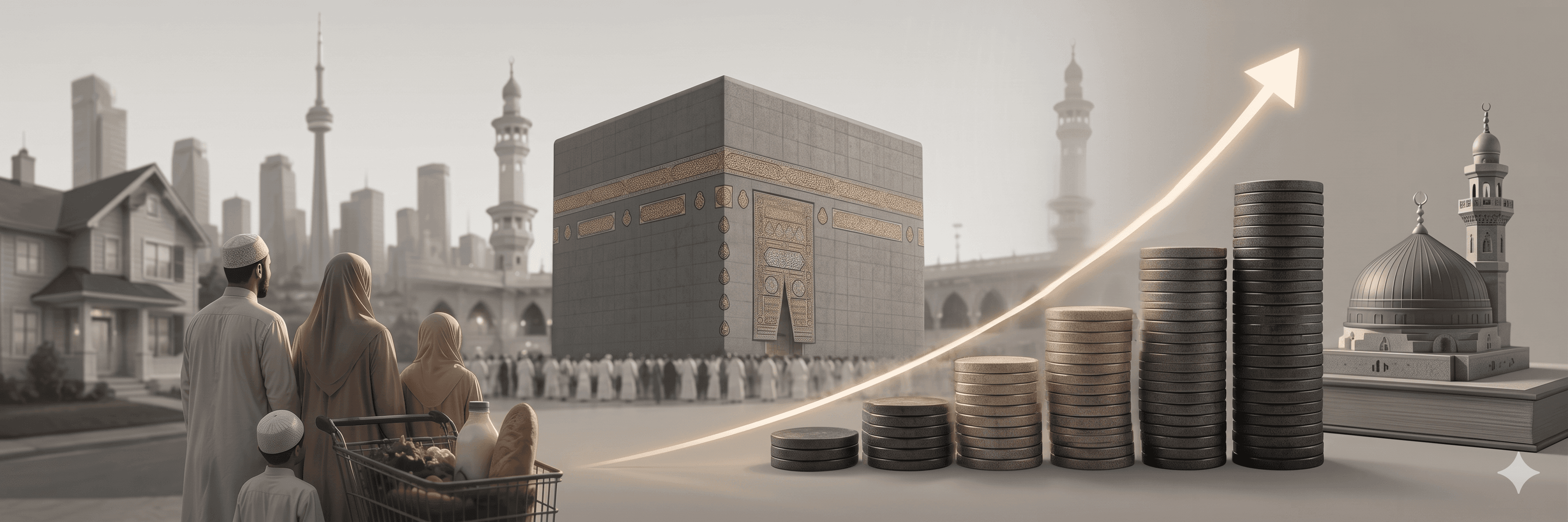
What once cost a family $7,000 now demands nearly triple that. Here is what is driving up the price of Islam's holiest journey and what to do about it.
For Muslims, Hajj is not a vacation. It is one of the Five Pillars of Islam a sacred obligation to be fulfilled at least once in a lifetime by those who are physically and financially able. That last phrase has always carried weight. Today, it carries more than ever.
For Muslims across North America whether in Toronto, Chicago, Houston, or Los Angeles the cost of completing Hajj has nearly doubled, and in some cases tripled, over the past decade. Understanding why is the first step to planning for it.
How costs have shifted over the years
Pre-2016 The Accessible Era A decade ago, performing Hajj from North America was financially manageable for a middle-class family with modest savings. Packages from Canada ranged from $6,500 to $9,500 CAD, while US-based pilgrims typically paid between $5,000 and $8,000 USD. Full-service packages coordinated by local Islamic travel agencies included flights from major hubs, decent hotels within walking distance of the Haram, and guided group leaders.
2023–2024 The Post-Pandemic Shock When global travel resumed, prices faced a massive structural shift. Saudi Arabia's Nusuk portal restructured ticketing, removing local travel agents from the process entirely. Canadian packages climbed to $13,500–$18,000 CAD. American pilgrims saw similar jumps, with packages ranging from $9,000 to $15,000 USD. Flight capacity constraints and rising fuel surcharges drove much of the increase.
2026 Historic Highs Prices across all tiers have reached levels that would have been unimaginable a decade ago.
What your money gets in 2026
Economy Canada: $12,500 - $16,500 CAD | USA: $9,000-$12,000 USD Accommodations farther from the Haram with daily shuttle buses. Expect to share a room with four to six other pilgrims.
Standard Canada: $18,000 - $23,500 CAD | USA: $13,000- $18,000 USD Zone A or B lodging, better catering, and double or triple occupancy rooms.
Premium Canada: $34,500+ CAD | USA: $25,000+ USD Five-star hotels directly facing the Haram, VIP tents in Mina, and direct flights.
The four forces pushing prices up
Jet fuel and airfare surcharges Millions of pilgrims converge on Jeddah within weeks of each other. That demand spike, combined with oil volatility, forces airlines into heavy fuel surcharges. North American pilgrims are especially exposed transatlantic routes are among the most fuel-intensive in the world.
Makkah real estate and hospitality inflation Zone A hotels sit on some of the priciest real estate on earth. Saudi Arabia's ongoing infrastructure expansion continuously raises lodging costs and those costs pass directly to pilgrims.
Saudi Arabia's 15% VAT Saudi Arabia tripled its VAT from 5% to 15%, applying it to every hotel night, meal, and bus ride. That tax compounds quietly across every line item in your package.
Currency exchange rates The Riyal is pegged to the US dollar, giving American pilgrims relative stability. Canadians feel a squeeze whenever the CAD weakens and for pilgrims in Pakistan or Egypt, currency devaluations have nearly doubled local Hajj costs overnight.
How to plan financially
The financial reality of Hajj means that last-minute savings is no longer a viable strategy. Achieving this milestone now requires deliberate, long-term planning.
Start saving now and put that money to work. Don't let Hajj funds sit idle in a checking account. Open a Shariah-compliant savings or investment account dedicated solely to Hajj. Even modest monthly contributions invested in halal funds over three to five years can meaningfully close the gap between where you are and what a package costs.
Treat it like a savings goal with a target date. Work backwards from when you realistically want to go. If a standard package costs $18,000 CAD or $13,000 USD today and prices rise 5–7% annually your target in five years is higher than it is today. Factor that inflation into your savings rate, not just the current sticker price.
Hedge against currency risk. North American pilgrims paying in CAD are exposed to USD fluctuations since the Riyal tracks the dollar. Consider holding a portion of your Hajj savings in USD-denominated assets to protect against CAD depreciation eroding your purchasing power before you book.
Compare packages like an investor, not a consumer. A lower upfront package price is not always the better deal. Account for what is excluded meals, Qurbani, local transport and calculate the true all-in cost. The cheapest headline number rarely reflects the actual capital outlay.
Time your booking strategically. Package prices fluctuate. Booking early in the registration cycle, before peak demand locks in higher rates, has historically offered better value. Treat it the way you would any time-sensitive financial commitment move when conditions are favorable, not when urgency forces your hand.
The macroeconomic forces driving these costs oil markets, currency fluctuations, Saudi tax policy are outside any individual pilgrim's control. What is within our control is how early and how deliberately we prepare. May Allah make the journey easy for all who seek it.
Sources: MCCA Islamic Finance · Muslim Planner